Quick answer
Crawl space encapsulation in Spokane Valley seals the space under the house from ground moisture and outside air: a heavy reinforced liner covers the soil and runs up the foundation walls, seams and edges are taped and fastened, vents and rim joists are sealed, and a dehumidifier holds the humidity down. Any leak, standing water or mold is handled first.
What encapsulation does and when it makes sense
Most older crawl spaces were built with open foundation vents and a thin plastic sheet, or bare soil, on the ground. The idea was that air would carry moisture out. In practice, the soil keeps giving off moisture, and outside air that is damper than the crawl space adds more. The result is damp joists, sagging insulation, a musty smell and, over time, mold and rot.
Encapsulation takes the opposite approach. The ground and the walls are sealed with a heavy liner, the vents are closed, and the air in the space is kept dry with a dehumidifier. The framing stays dry, the floors above stay warmer, and the smell goes.
It makes the most sense after water damage, when the crawl space is already open and the old barrier and insulation have come out, or when a crawl space keeps getting damp. If water is under the house now, the job starts with crawl space water damage cleanup; if mold is on the framing, crawl space mold remediation comes first.
What is included in our encapsulation
- Moisture readings before and after, with photos
- Removal of old barrier, wet insulation and debris
- Reinforced liner over the floor and up the foundation walls
- Taped seams and sealed edges, piers and penetrations
- Sealed foundation vents and rim joists
- Dehumidifier with a drain or pump, set and checked
- A check of gas appliances and combustion air before sealing
Sealed heavy vapor barrier
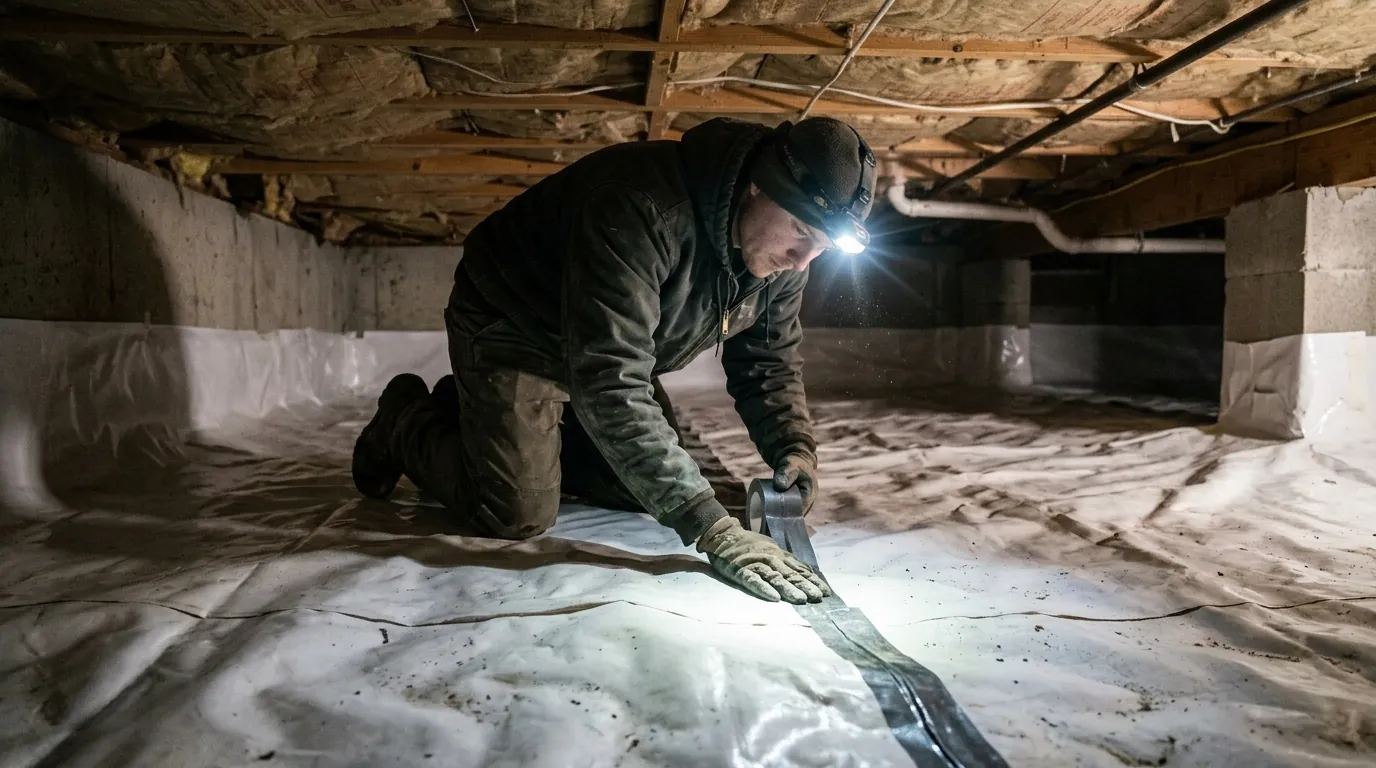
The liner is a reinforced polyethylene sheet, much heavier than the thin plastic most crawl spaces have. It covers the whole floor, overlaps at the seams, runs up the foundation walls and is fastened and sealed at the top edge and around piers and pipes.
Seams are taped so ground moisture cannot come up between sheets, and the liner is durable enough to crawl on when someone needs to get to plumbing later.
Vent and rim joist sealing
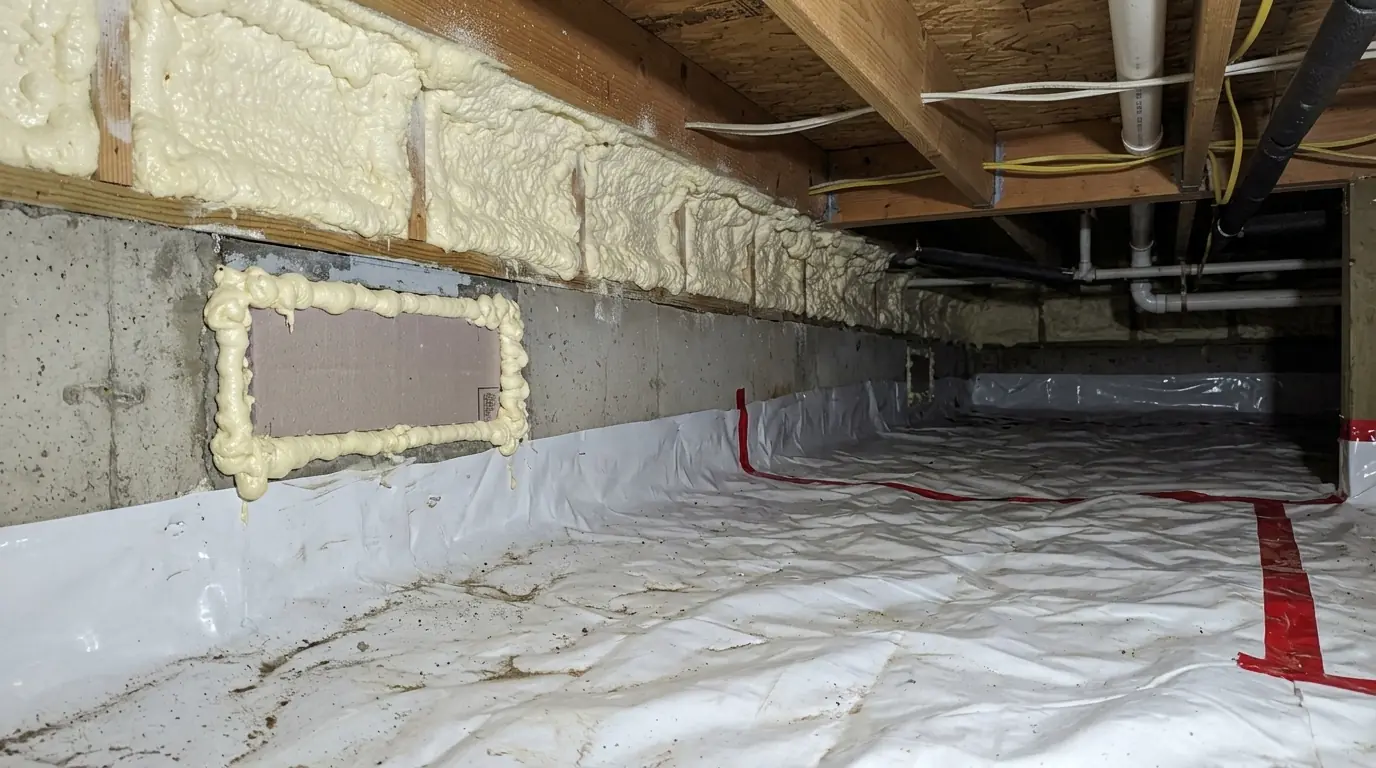
Foundation vents are closed and sealed, and the rim joist, where the floor framing meets the top of the foundation, is sealed and insulated. That is where most outside air and cold get in.
If a gas furnace or water heater sits in the crawl space and draws combustion air from it, sealing the space changes how that appliance gets air. We check this before anything is closed.
Crawl space dehumidifier
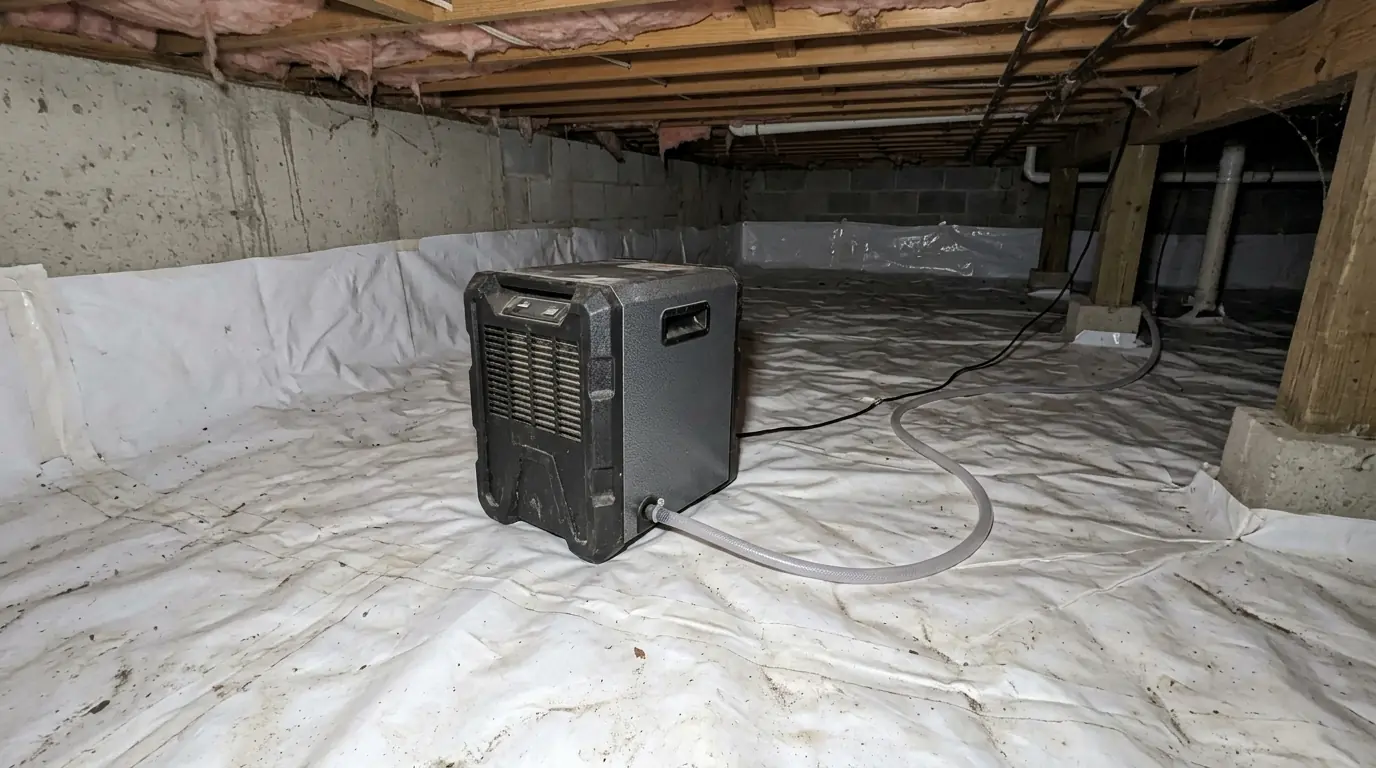
A dehumidifier sized for the space runs in the sealed crawl space and drains to a pump or a floor drain. It keeps the humidity low through spring thaws and summer storms.
We set it, check the readings after a few days and show you where it drains and how to check that it is running.
Spring moisture and gas appliances under Spokane Valley floors
Spring is when most crawl spaces in the Spokane area get damp, as snowmelt and rain raise the groundwater; in March 2017 the Spokane River rose above 27.5 feet, past its 27-foot flood stage, for the first time since 2012, and Spokane and Spokane Valley closed the river to users. Sealing a crawl space has a local catch too: utility gas is the most common heating fuel in Spokane Valley and Spokane, and a furnace or water heater in the crawl space may rely on that air.
How an encapsulation runs
- 1
Inspect and read
Moisture readings on the soil, joists and subfloor, and a check of appliances in the space.
- 2
Fix what is wet
Leaks repaired, standing water removed, and the space dried if needed.
- 3
Clear the space
Old barrier, wet insulation and debris removed and bagged.
- 4
Line and seal
Heavy liner installed and taped; vents and rim joists sealed.
- 5
Dehumidify and verify
Dehumidifier installed and readings checked after it has run.
Planning costs for crawl space encapsulation
Encapsulation depends mostly on the size of the crawl space, its condition and how much of the system it needs. This national range is a planning guide.
- Crawl space sizeLiner, tape and labor all scale with the square footage.
- ConditionOld barrier, wet insulation, debris or mold have to come out first.
- Clearance and accessLow, tight crawl spaces take longer to line.
- Dehumidifier and drainA dehumidifier, condensate pump or sump adds to the cost.
- Appliances in the spaceGas appliances may need combustion air changes.
Vapor barrier, encapsulation or conditioned crawl space
These options get confused on the phone. Here is how they differ.
| Option | What it includes | When it fits |
|---|---|---|
| Basic vapor barrier | Thin plastic over the soil; vents stay open | Dry crawl spaces with no history of moisture |
| Encapsulation | Heavy sealed liner, sealed vents and rim joists, dehumidifier | Damp crawl spaces, after water damage or mold |
| Conditioned crawl space | Encapsulation plus a small supply of heated or cooled air | Homes where the crawl space is treated as part of the house |